
From twodollarradio.com:
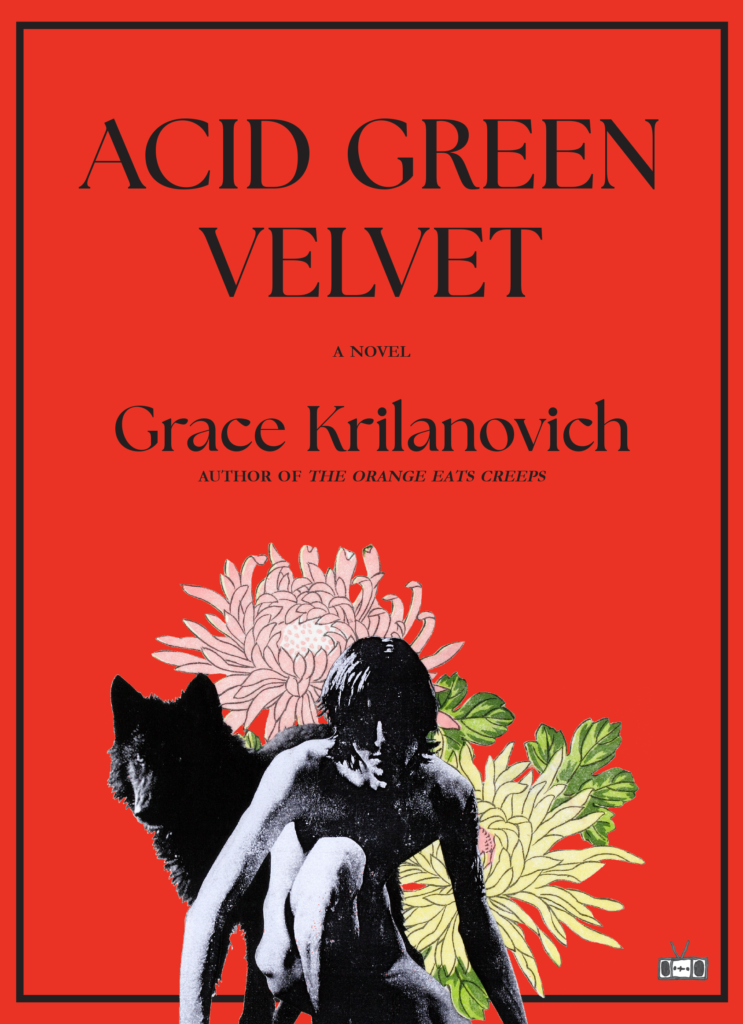
The breathtaking and consequential first novel in nearly two decades from the award-winning author of the cult sensation, The Orange Eats Creeps.
In the late 19th century on a remote California beach, two young tramps — Paulette and Kenneth — threaten to kill a menacing man who wronged them: Paulette’s father, Rodney Eligon.
A handful of years later, the Central Coast town of Anzar has become the stomping grounds for all manner of cults, eccentrics, earth religions, and communal living. Presiding over the town from the luxe frivolity of their family manor, the Hasleys have ruled Anzar for generations. Their grip on the town is threatened by the rise of the working class, and their union with the vagrant population. Meanwhile, Paulette has taken up residence in the home of Johnny Hasley, a wealthy faux-socialist poseur, hoping to become his wife. Her plans are complicated by boot-prints in the garden signaling the arrival of Kenneth, who carries with him a dark secret that poses a grave threat to both of them.
In Anzar’s cracked mirror, Californian freakiness meets Victorian preoccupations with the domestic, pollution and filth, haunted houses, fringe societies, living death, spiritualism, vampiric women, and class parasites. Acid Green Velvet is a surreal powder keg of nihilism, fathers and their failures, manifest destiny, and American identity, penned in rapturous prose by the fiercest writer of her generation.
“victorian kitsch,” “Hobohemia,” and
the fringe:
A conversation with Grace Krilanovich

Our editor-in-Chief John Hanley & Grace krilanovich, author of the cult classic the orange eat creeps and her forthcoming novel acid green velvet, discuss vagrancy, violence, and the “Fringe.” Read the full interview in full below, and pre-order Acid Green velvet Here.
THE INTERVIEW
Between your cult classic The Orange Eats Creeps and my peek at your upcoming novel Acid Green Velvet, I noticed that there are elements of both that feel very reminiscent of “hangout” movies – the violent-vagrant youth theme in particular certainly recalls films like Harmony Korine’s Gummo/Kids and other similar offshoots. Characters hang around, wreak havoc, mollify themselves with sex and/or substances, and so forth.
But that group dynamic is also intercut (and undercut) with a feeling of profound, melancholic loneliness, as our protagonists try to find a place in the world in the absence of love or support. Can you talk a little bit about this interplay between loneliness, selfhood, and belonging in your work?
I don’t necessarily see it as loneliness in my own characters. Maybe it’s my blind spot, but I just don’t think of them as lonely. It’s something else, a supercharged aloneness perhaps. More a vocation, than a circumstance that happens to them. These characters persist in peeling away the layers of societal constructs, questioning every given, at great personal risk. They might find other like-minded people, but these alliances are fragile, and in the end aloneness is this final frontier they’re all barreling toward, a grim kind of existential purity.
For me, the “hangout” element is mood. I’m trying to create mood within the defined surroundings, where you could envision going off the official narrative and poking around in other characters’ houses, walk around the bend of a particular road or whatever. Part of it is making sure there’s stuff to look at. The stuff does a lot of work, narratively. The characters do their thing in this space you’ve filled with stuff, trash included, and it adds up to a certain feel.
Maybe because there’s this push to limit or smooth out the experience of being in public places, these days I’m more conscious of observing ordinary surroundings, and being present and connected through looking. No pleasantry or detail is too trivial, whether I’m sitting in a doctor’s office, the supermarket checkout line, the school auditorium… There’s torn, smudgy Xerox signage all over the Post Office; there’s bales of Costco “Marathon” toilet paper piled up in a corner of a coffee place, etc. I feel it’s my duty to simply look around.
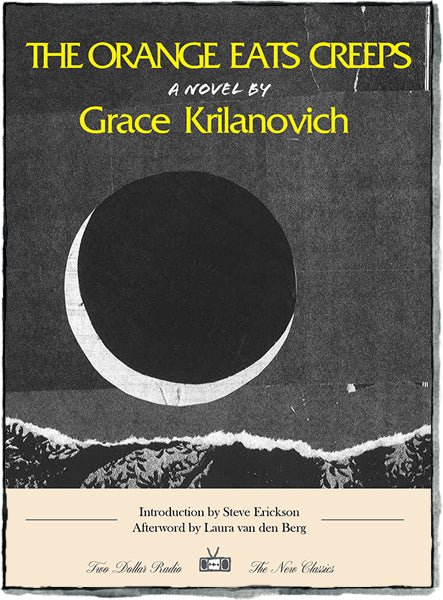
Re-issued in 2025 by Two Dollar Radio
for the New Classics series
Based on the excerpt I read, the stakes and conflicts of the new novel feel very concrete, as compared to The Orange Eats Creeps’ Lynchian surrealist nightmare following the transient wanderings of the protagonist. I’m wondering to what degree this new novel will follow a formal plot structure, or whether it, too, will transform into atmospheric surrealism. As a writer who clearly values and prioritizes style/voice, can you talk a bit about how you balanced abstraction, style, and plot when approaching this new novel?
Acid Green Velvet is twice as long as The Orange Eats Creeps, so it needed more structure. With AGV I wanted to play with different genres and motifs, and then let that give way to more impressionistic surreal passages, similar to OEC. You’ll find the new book dipping into a variety of modes: what I would call “Victorian kitsch” and melodrama, haunted house, labor revolt, succubae, killer dog.
I started writing it in 2007 using Elvis Presley as a template for the main guy. I focused on Presley’s washed-up early sixties years, when he’d installed Priscilla at Graceland under somewhat depraved pretenses. After a while the story morphed into an alternate universe California. I was always intrigued by the hippies’ embrace of Art Nouveau/Victorian style, trippifying the old SF Victorians and cavorting in bedazzled frock coats and feathered capes. Of course the 19th century had a proto-hippie thing going – communes, fringe societies and health cults. I thought it’d be interesting to knit together the two eras. Gilded Age meets the Age of Aquarius. In general, I enjoy taking the hippies and flower children down a peg. Or just playing around with them. Growing up in the 80s it was always shoved down our throats how they were the fucking best and every subsequent generation was just a failed approximation of this pinnacle of youth culture.
My supreme wish was to write something propulsive and readable. I was jealous of the crime novels I was reading; I wanted whatever they had that allowed them to achieve that momentum. But could it also be weird? Would the reader tolerate that? I know if I was reading it, I’d want that hallucinatory sick feeling, that out of control feeling to balance out the other elements.
AGV is putting societal and class tension right at the forefront. While the novel is set in the late 1800s, there are elements here that still ring as relevant today – immigration, homelessness, class disparities. What was on your mind, whether personally or politically, as you were writing this novel? What did you find yourself stewing on the most?
I guess you could say I’m stewing on misogyny and the denigration of the feminine. That is the major current, and it shows up in Acid Green Velvet in the conflict between the corseted, fussy, trinket-laden woman’s sphere; the stuffy dark rooms constantly needing upkeep; and the wilderness, Industry, the “real stakes” Authentic world of men.
The stupidity of tradwifery and some high fashions I’ve seen recently of a super stylized, confined and exaggerated female form makes me feel like, yeah, get the 19th century up here to point some things out. They’re easy targets, but the Victorians (or maybe I should qualify them as “Pop Victorians” in our current imaginings) are so deliciously excessive and obvious in their hang-ups. Very rich in iconography, drama.
I’d hoped that even though it’s set in the 1880s that the novel conveys something about now in a way that you don’t get if you write about it directly. The displacement helps us see what we’re in the midst of. I’m thinking of an example, Oakley Hall’s Warlock, a western set in the 1880’s but emerging out of the McCarthy era to comment on those times.
I also wanted to pay tribute to the “hobohemia” so lovingly chronicled in Boxcar Bertha. Not the movie, but the fake autobiography of a woman hobo written by the anarchist-abortionist Benjamin Reitman. He clearly felt the need to provide a record of a lost or thwarted movement, centered in Chicago and places like the Dill Pickle Club and Bughouse Square in the 1910s through the 1930s. Incidentally, after reading his biography, Reitman struck me as an irredeemable buffoon and Lothario in real life, but his milieu was legendary.
Another theme present in both novels, and in the case of Acid Green Velvet, right out the gate: youth, parenthood, parent-child relationships. AGV challenges and subverts these ideas immediately, and with violence. And in both novels, we feel a profound sense of absence, or failure, or lacking, from parental figures. Can you expound a bit on the role of parents (and parental/familial absence) in your writing?
The parent-child thing keeps figuring into my work. These are foundational relationships, obviously. But part of what I’m trying to do is make it bigger, as family structures, as they exist now, relate to state power and the way social hierarchies work.
Family histories and intergenerational dynamics are forever intriguing. In Acid Green Velvet there’s an elderly woman character, Johnny’s grandmother, who is partly based on my own great grandmother. I was privileged to know her growing up. She lived across the street from my family, and just struck me as this extremely ancient person. She was born in 1902, so in her late 80s then, and to a kid that is unfathomably old. Not that she’s a sympathetic character necessarily in AGV – and she was a frightening and complex figure in my childhood – but I wanted to pay tribute to her. She really was my living link with the 19th century, with the stories she told about her dad who was a jockey from the West Indies and about our town Santa Cruz in the teens and twenties. And I cherish those early sense memories of her dark, musty house cluttered with hundreds of elephant tchotchkes, and how she would sip water from a little spring in her backyard, just dip her hand into it like a caveperson.
A question I must ask: it’s been 15 years since your last novel-length fiction release. How long have you been working on AGV – has it been many years in the making, or is it a relatively recent re-entry? If it’s the latter, how did it feel to be writing a novel again?
I started writing Acid Green Velvet in 2007, right after I completed The Orange Eats Creeps. AGV went through a few drafts, then I started having children (kind of a lot, three), which ground the book to a halt for ten years. I worked on it very little, a couple hours per week, till my youngest went to school in 2022. Once I got my time back I churned out the last few drafts and was done in a year and a half.
Now that I look back, it’s clear that if I’d somehow managed to finish this book in 2014 or 2015 like I was trying desperately to bring it to a close then, it wouldn’t be half of what this book is now, the AGV that’s being published in September. As hard as it is to look back over these 15-plus years, I ended up with the novel assuming its true and proper form.
That said, if I’d somehow known in 2015 that it would take another decade to finish, I would have dropped it immediately! I couldn’t write knowing that – who could?
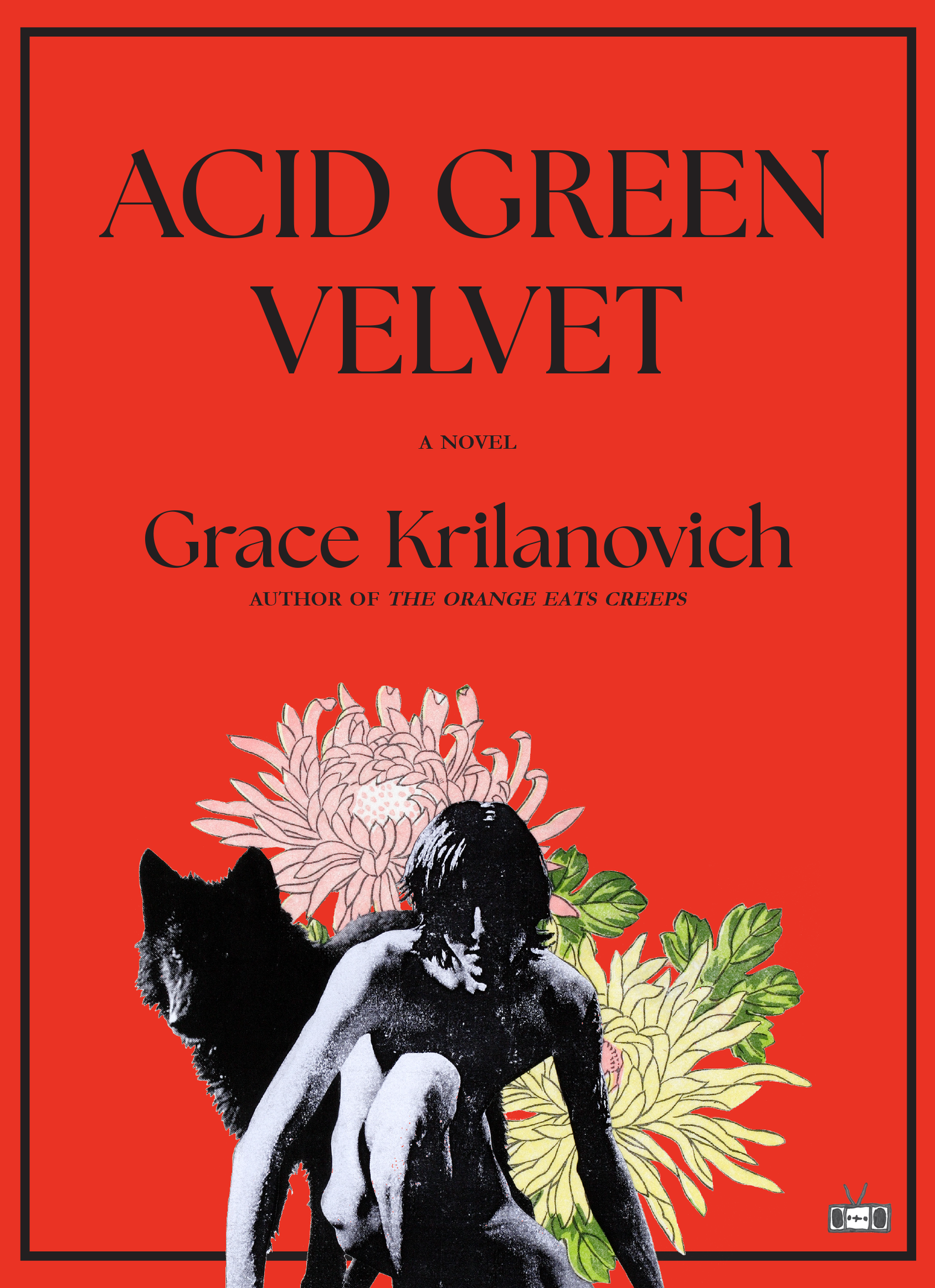
Back to the topic of themes, I’d love to talk a bit more about the “fringe.” There is a feeling of liminality that permeates in your work: characters living on the fringes of society/lucidity, periodically coming into contact and clashing with the “real” world. We slide between dream and reality; Paulette, the protagonist of Acid Green Velvet, quite literally lives in a sleepless fugue state with her lover-roommate-benefactor-client-patient (did I get that right?) Johnny. What do you see as some of the thematic and creative joys (or dangers) of exploring the “fringe,” both within the story and as a part of the writing process?
Acid Green Velvet engages with different kinds of dreams – there’s collective fantasies about place, fantasies of how the characters see themselves, warped recollections of their pasts, there’s “problem solving” dreams, and transmissions from other realms, hallucinations of ghosts and invading spirits. The two main characters see themselves as living on the fringes of society because they’re wealthy shut-ins and if they’re mingling with the “common people” it’s from almost an anthropological position. The girl, Paulette, comes from the street, though, so that complicates it. She goes from one fringe to another.
In Acid Green Velvet there’s repeated talk of “shadows” as liberatory places, a liberatory state of being. The idea that the revolutionary can live free and operate within a shadow realm. That’s a core tenet of the fictional “Nascent Freedom Movement” in the novel.
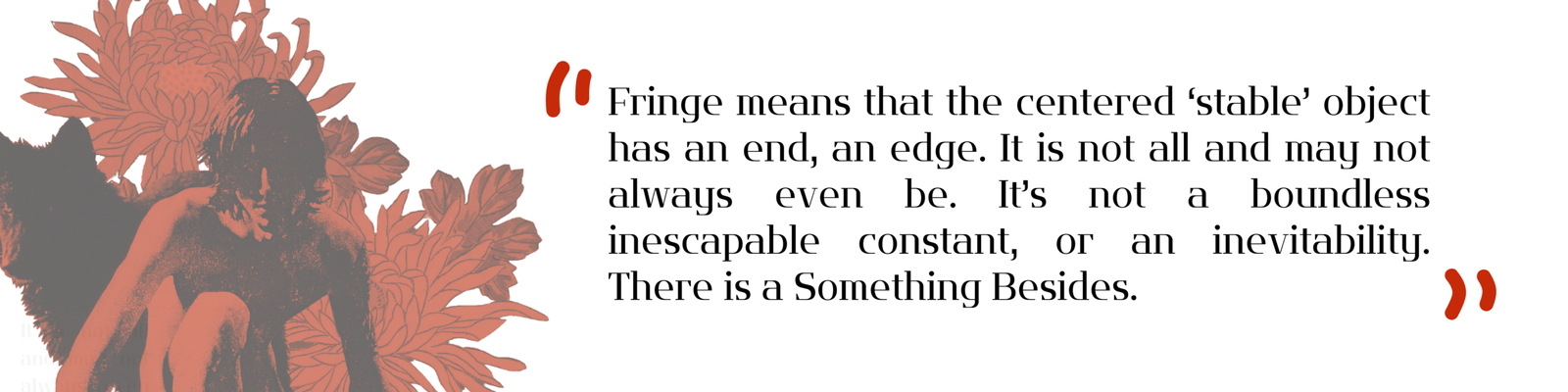
Fringe implies a conditional relationship, a shadow belonging to the “real” object. It is peripheral to the main thing. But there’s also the idea that the existence of fringe means that the centered “stable” object has an end, an edge. It is not all and may not always even be. It’s not a boundless inescapable constant, or an inevitability. There is a Something Besides.
Fringe implies dynamism, a prompt to action. Fringe also implies “multiple,” like there’s not just this main thing and one alternate. It’s going to be a collection of alternatives. The idea of Fringe in horror can point toward an unsettled place where ambiguity and possibility live. Maybe that’s all gathered under the Uncanny (like, “this thing is disturbingly close to the thing, but is so not the thing”).
On the same note: there seems to be a conversation happening within your writing about the inherent violence of the fringe, but also the humanity of those that must navigate it. Characters must assert their dignity and autonomy, must find ways to maintain a sense of self amidst a wash of turmoil, violence, betrayal, assault. On the flip side of that coin, mainstream institutions perpetrate just as much violence and are clearly not a safe space for these characters, either. What insights do these edge spaces give us about navigating a harsh world?
There might be punishment for those who pursue alternatives. Yes. Navigating the fringe, living in rejection of mainstream institutions, means you’re their mark.
But there’s far-right fascist cranks there too, in these edge spaces, and they’re also pledging violence on whoever’s out of step with the mainstream institutions.
I’ve been talking about Fringe as a liberatory space, but hey, liberatory for whom? Neo-Nazis run rampant on the fringes of society. I guess you could call them liberated for evil. The fringe is not progressive by default, of course.
Coming of age in the 90s, I remember a lot of focus on “extremes” and alternative-seeking in culture, amid ideas that mainstream meant lame, boring, and lacking all credibility. The fringe was where the freshness was. Counterculture publishers RE/Search, AMOK, and Feral House came in like clearinghouses for remnants of lost or maligned histories, and those figures on the contemporary fringes as well. I’m thinking specifically of the “chaos bible” of Fringe championed by disgusting Adam Parfrey: Apocalypse Culture I & II. Now we know one of Parfrey’s goals was to introduce fascist ideology into the counterculture, and spur the growth of neo-Nazi movements in the US. This goal was achieved. He slipped it in there with the outsider art, esoteric philosophy and underground music as just more “fringe content.” Talk about betrayal. This is all presented at length in Spencer Sunshine’s book Neo-Nazi Terrorism and Countercultural Fascism.
With all that violence, everything and everyone feels like a threat in the worlds of your novels – even the atmosphere itself. (Your synopsis of Acid Green Velvet specifically notes “filth and pollution” as a theme.) Can you tell me more about the atmosphere – dread, fatalism, gloom, cruelty – that seems to permeate in these worlds?
I wanted to find something transcendent in filth and pollution – a necessary rejection of purity as an ideal, at any rate. A society angling toward “purity” is the biggest threat of all.
I wanted to explore that though a particularly Victorian lens. In the book we’ve got industrialized cities, itinerants, leisurely tramps and the leisurely well-off. Class parasites and confidence tricks. Bad air. Toxins, contagion – the racism of that in fascist discourse. And also the misogynist ones, that women cloud and pollute men’s minds, they are at once filthy, AND overly scrubbed and altered. I thought it would be interesting to blow up some of these themes – like you mention, dread, fatalism, gloom – to camp proportions. That’s what I meant by Victorian kitsch.
One last question on the topic of fringe. For writers who want to explore these societal fringes – things like homelessness and extreme poverty, for example – it can feel like a struggle to avoid what might colloquially be labelled as “poverty tourism” and/or “trauma porn,” particularly if the writer has not themselves experienced it. How do you ride that line, and what advice might you give to writers wanting to explore similar topics?
Exploitation as a genre in movies or pulp paperbacks is like “Give the people what they want!” which is why they are fun and beloved. But Exploitation has this line. There’s no fun in prurience. Sleazy: cool. Raunchy: not cool. I would draw a distinction there. Raunch is sleaze stripped of joy.
Linking “tourism” to subject matter implies that you’re either offering readers a chance to “visit” another’s experience while keeping that distance, denying that identification in favor of satisfying disingenuous curiosity about human experience as an object on display, making it so the reader’s enjoyment of the text is based on this distance.
What I don’t want to do is stylize or aestheticize human misery. In writing characters who are acted on violently by society and are forced onto the fringes, it’s not a matter of just having good intentions. Something needs to be offered to the reader on the page when they’re presented with a homeless character, for instance, that denies them the refuge of that distance.
Do you consider yourself a horror writer? What is horror to you – as a genre, label, and/or classification – and where do you think it fits into your own writing?
I don’t consider myself a horror writer, but I incorporate horror elements in my writing and I love it when The Orange Eats Creeps gets shelved there or talked about in this community. I don’t feel very well versed in contemporary horror, though, but that’s because I’ve been in research mode while working on the second book.
Acid Green Velvet is definitely engaging with some genres – Western, most prominently. You could define it further as Acid Western, Gothic Western. And to me, if it’s either of those, that’s because Horror is involved. The book isn’t scary, but I was hoping for a pervading sense of unease in the house and wilderness surrounding the town. A pack of doglike monsters is going around killing members of an activist group. The mansion has anomalies. I would consider these the book’s horror tropes.
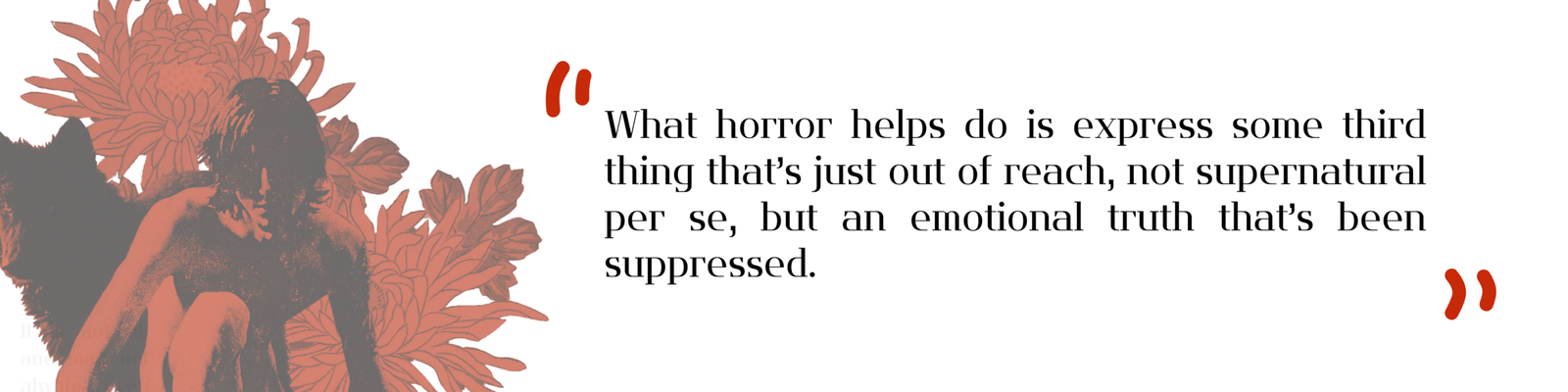
In a larger sense, horror is a tool I use to create dynamism in the text (“Crime fiction, but make it Horror”). What horror helps do is express some third thing that’s just out of reach, not supernatural per se, but an emotional truth that’s been suppressed. It’s cathartic as a reader to encounter this unearthing of a buried thing. And I love the stylized, delirious or even camp element to horror and the gothic. The use of artifice that invites the reader to fill in blanks, guess at what’s under the mask. I’m sure there’s some psychoanalytic theory for what I’m trying to articulate.
Another obligatory question, although I’ll give it a bit of a twist: what or who were your creative inspirations when writing Acid Green Velvet, and in general? Feel free to list books, films, art, and music, but also foods, textures, animals, moods, sounds, spaces, and the like. Be as literal or as metaphorical as you’d like.
Dollhouses, migraines, silent film, clowns, figure drawing, nightgowns, cave art, Reitman’s Boxcar Bertha, Jack Black’s You Can’t Win, Occupy Wall Street, when bikers took over Hollister, when the Manson Family took over Dennis Wilson’s house, the Human Be-In, the Durst Ranch hop riot, Lucifer Rising, Morticia Addams, Anne of Green Gables, Elvis & Priscilla Presley, Arthur Lee, Mary Pickford, Ken Russell, Wanda Gág, Tasha Tudor, the Winchester Mystery House, hyenas, buzzards, coyotes, mules, Bram Dijkstra’s Evil Sisters and Idols of Perversity, Scott Treleaven’s art, the Victorian interiors book The Tasteful Interlude, Wisconsin Death Trip, Shirley Jackson’s We Have Always Lived in the Castle, Queen Margot, Withnail & I, Joe Coleman’s art, The Wolves of Willoughby Chase, The Little Fur Family, Barry Lyndon, Charles Portis’ Masters of Atlantis, OWL Farm, San Benito County landscapes, the forest of Nisene Marks, The Eating in Bed Cookbook, Juan Rulfo’s Pedro Páramo, James M. Cain’s Past All Dishonor.
Finally, our Issue Three theme, as this interview suggests, is FRINGE. As our submitting writers tangle with this theme in their stories, foraying toward those dark and fuzzy edges, do you have any last bits of inspiration or wisdom?
I experience a tension between wanting to retreat into the dark fuzzy edges and wanting to pointedly engage with reality outside. It’s a paradoxical twin impulse springing from stressors of the time period, where we’ve got an idealization of smooth frictionless movement through public space amid a daily barrage of socio-political horrors.
I hope this book “makes sense.” I mean, existentially. Because there’s just so many books, every year, thousands. People have many choices in what to pick up – can I justify adding one more to the pile? Can I justify taking the reader’s time and shelf space? Can I justify taking their time away from reading the news?
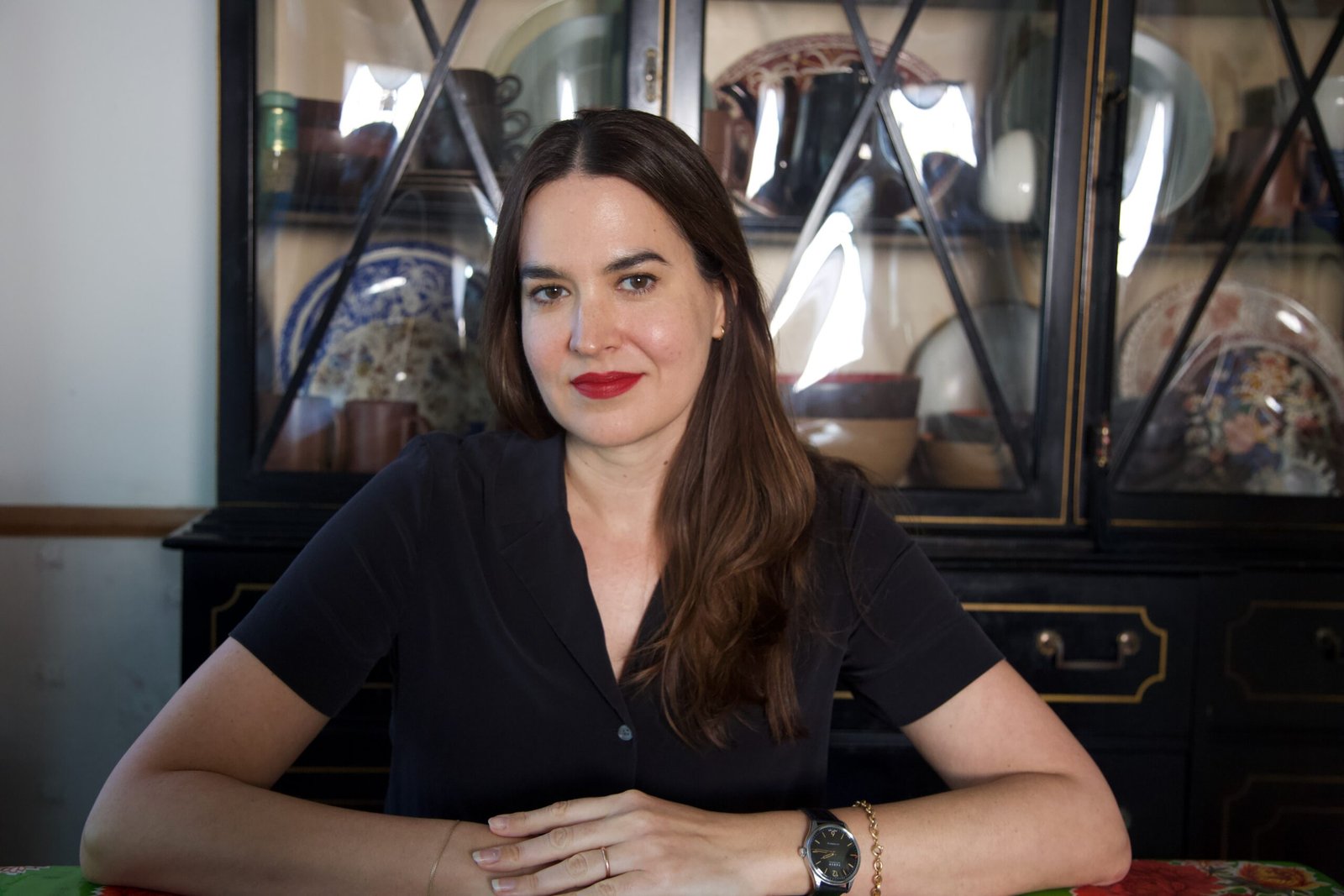
Grace Krilanovich is the author of The Orange Eats Creeps, a finalist for the Believer Book Award and the Indie Bookseller’s Choice Award in 2010, and reissued in 2025 for Two Dollar Radio’s New Classics series. Her work has appeared in Black Clock, The Rumpus, The Comics Journal, Los Angeles Review of Books, and elsewhere. She was a National Book Foundation “5 Under 35” honoree in 2010. Her second novel, Acid Green Velvet, is forthcoming from Two Dollar Radio in September 2026. You can pre-order it here.