
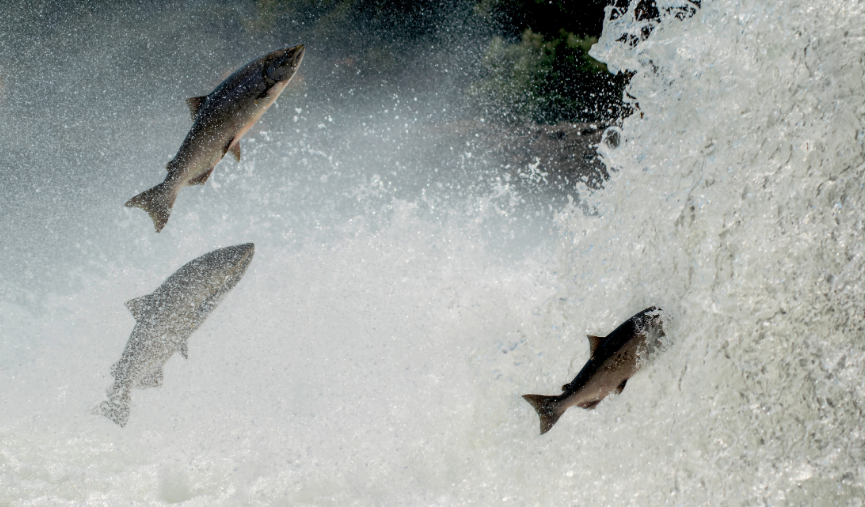
The Salmon Eater
by Shantell Powell
This story is the second place winner of the
2026 NECKSNAP x M E N A C E Emerging Voices in Speculative Horror Prize.
Ímarasugssuaq was taller than any man I’d ever seen before, and his skin paler, too. He may have been one of the vanishing ones. There were few of those people left, those ones with their houses of rock, sod, whale bones, and strange wooden floors. He came to my father’s camp late in the winter, when the seals were having their stillbirths. He did not bring anyone with him. Not even a team of dogs.
I wondered what sort of man travels without dogs. So too did my seven brothers. How did he keep himself safe from bears? He carried a sack full of salmon, and this he set down by our snow house as he pushed aside our growling dogs with his foot and called to greet my father.
“I have come looking for a wife. I hear you have a daughter who is good at making things.”
My father examined the gift of fish. They were big, fat salmon, bleeding from their gaping gills. Their skins shone like wet ice, and the flesh was a bright and beautiful orangey-red. It was not right that he had such fish this far north. It was not right that he had them in the season when premature seal pups died from the cold. Yet despite the season, the fish were only now starting to freeze.
My father looked at him. “What is your name, fisherman?”
“Ímarasugssuaq.” He looked over at me and smiled through a puff of breath. His walrus tusk labret twitched. His round brown eyes were tattooed at the outside corners. “Will you come with me?”
It was time for me to start a family of my own, and I could do worse than this tall, pale man in his fur-lined coat of tanned fish skins. And I’ll admit I found him good to look at. I smiled and squinted my eyes to say yes.
While my brothers and father shared a meal with my new husband, I packed my sewing kit in a basket made from the skin of duck feet. I brought seal oil and arctic cotton. I carried my qulliq, ulu, and amaaq. I would have brought puppies, too, but my new husband scrunched up his nose to say no. He left the bountiful fish with my father, and after I hugged and kissed my family goodbye, my husband and I headed off across the ice to my new home.
Ímarasugssuaq barely said a word to me on the trip. It was as though he’d used up all his words addressing my father. We clambered across treacherous pack ice and walked with heads down across squalling tundra. Climbed a slippery mountain so high it scraped the low-hanging aurora. When I slipped and would have tumbled down the mountain, Ímarasugssuaq grabbed my arm and steadied me.
Green and purple lights danced across the darkness, and here and there, ribbons of red trickled down from the sky. This was the place where the spirits of those who bled to death resided, and not wanting them to notice me, I kept my eyes down.
Ímarasugssuaq used his snow knife to build a small iglu near a rock face, and once inside, I set up the qulliq, filling it with seal oil and tending the cotton wicks with my amaaq. He gave me a fresh salmon to eat. I did not know where it came from, but I alternated between watching the qulliq and eating the fish. As soon as the qulliq made it warm inside, we undressed and slept, nude bodies coiled together like intestines between a blanket of our clothes. At one point I awoke to whispers filling the air. I thought it was the hiss of blowing graupel, but wasn’t sure. I relit my qulliq and listened more carefully.
It was not the wind. It was not the ice.
These were voices. Whispers from the dancing sky intermingled with voices from low down on the body of my sleeping husband.
Run away. Return to your brothers and your ataata. Run away.
I leaned closer to my husband. Some of the voices came from the dark pelt between his legs. Freed spirits might live in the luminous dark sky, but those which are trapped inside someone are imprisoned within bladders.
I reached for my clothing, but Ímarasugssuaq awoke and looked at my naked body. My thigh tattoos danced in the flickering firelight. I composed myself and smiled at him. “Ullaakkut. Good morning.”
He looked me up and down, then pulled a salmon out of the air. It flopped in his hands before he bit its head and killed it. He handed it to me. “You are too thin. Eat.”
I did not show my surprise. He must be an angakkuq, too, with different knowledges. “Will you not eat as well?”
He licked his lips and wrinkled his nose to say no. “I am not hungry.”
But I did not believe him. His eyes said otherwise.
Because I didn’t know when I’d next get to eat, I dressed and ate. My mouth was so dry, I would drink anything–even the dirty melt water on the iglu floor. I was about to when he stopped me.
“We leave now,” he said.
And so we set out again, and the blood from the fish I had eaten had to suffice.
When I was almost out of seal oil, we finally arrived at my new home. It was a strange house of bones, stones, earth, and wood abutting a hill. It was built alongside a river in the crack between two tree-covered mountains. I had never been this far south before. Had never seen living trees. They stabbed at the sky like harpoon heads. There was a qajaq, but no other houses. No dogs. No other people. No signs of life save the whistling of wind through the ravine, and the whisper of wind through tree needles. Deep down in my marrow, I knew this was a place of the dead.
Though I was still thirsty and the river was right there, my husband still would not let me drink. I tried to scoop up some snow to melt, but he shoved me through the whale jaw doorframe and into the house. Then he threw more fish in after me. He shut me in so that I could not leave, and I sat with myself in the darkness in a room that smelled of fish, copper, and soot.
Only the faintest shadow of light filtered in through the chimney hole in the roof. I lit my qulliq with oil I found by feeling my way around. The walls were hung with furs. Behind these skin hangings was a wall of earth. I smoothed the furs back down and looked around some more. A pile of clothing was heaped in a corner. I rifled through it and found an abundance of breeches, kamiit, and several amautiit, the coats of mothers. They were all in different sizes. When I rubbed the fur trimming the hood, dried blood flaked onto my hands. I wiped my hands on my breeches.
There was a queer stove in the middle of the house with a cooking pot nearby. A small stack of wood, kindling, and tinder leaned against a wall. The stove had fish bones amongst the ashes. I lit the stove and smoke spiraled out the little chimney hole in the roof. I wished I could follow it, but knew better than to leave my body behind untended. Though it was now warm, I shivered at the thoughts of all those clothes–especially the amautiit. I chopped up the fish with my ulu and sucked up their juices before cooking them in the pot. They were fatty and delicious, but it wasn’t enough. My head ached. My mouth was so dry my lips stuck to my teeth. When I tried to close my eyes, it seemed like there must be gravel beneath my lids. I went to the wooden doorway of the house where a few flakes of snow had drifted in, and I licked at it until my tongue had splinters.
There was nothing for me to do, so I picked lice out of the furs and my hair and flicked them into the flames.
That night my husband rejoined me. I wiped off the bit of snow that came in on his clothes and ate it. “Where did you go?”
He did not answer.
We laid down together beneath our stacked clothes, and he poked at my flesh. “You are still too thin,” he said. “Eat more fish.”
“Too thin for what?”
He said nothing.
“Who do all those clothes belong to?”
He rolled over and went to sleep.
I could not sleep. I slipped out from under the furs and crept over to the door. Try as I might, I could not open it.
Then the voices of the dead came to me once more. Not from the sky, this time, but once again from the hottest place on his body. Whispers poured out from his groin, and I tipped my ear closer to listen.
He will make you fat.
“Pregnant?” I asked. I hoped. I wished.
You will be his meat. You will join us.
I had heard of such things. When hunts fail and there is no food, the starving times drive the famished to unspeakable actions. But my husband was strong. His muscles were hard and not spongey. His belly was soft with fat. He could pull fish from the air at will.
My voice was barely a whisper, itself. “Why would he want to eat me?”
My husband snorted in his sleep, and the voices did not answer.
When the fire went out, I stayed close to my husband for warmth. Even though his body radiated heat, my skin prickled like a plucked goose.
The next day, more light filtered in through the chimney hole than the day before. The season was changing. By now, healthy seal pups grew fat on their mothers’ milk and carved out caves of their own between slush and drifting snow.
Ímarasugssuaq woke up and we began putting our clothes back on. Our kamiit had frozen overnight, and we banged them on the floor several times to soften them up enough to get our feet back inside them. He went outside and I tried to follow. “No,” he said, and shut the door behind him.
I heard chopping sounds, and sometime later, he opened the door and flung in an armload of firewood. It landed all in a tumble, and he shut the door behind him again. This happened several more times, and I licked the ice off the wood before stacking it neatly. Some wood was dry enough to burn, and I once again lit the stove. The last time he opened the door, he threw in more fish and then went away without saying anything.
The glow of the fire from the open stove door provided me with more light. I searched the house more thoroughly and found a little bone dagger in the piles of clothing. This I hid in my kamiit and then I ate the fish.
Another season passed this way with my husband feeding me nothing but fish and never allowing me to drink. When he was away, I used the knife I found to whittle at a piece of driftwood that had faded white as walrus tusk. From this I fashioned for myself an amulet of protection. By the time of year when my brothers and ataata would be living in the skin tents, my body was soft and large. Now my husband looked at me longer before telling me I was still too thin. If I was not careful, soon I would no longer be too thin.
When he brought fish to me, I only ate a little. Each day, I used my knife to dig a hole into the wall behind the furs. I burned fish instead of eating them. And when it rained, I caught the water falling in through the chimney hole in the cooking pot and drank it.
Now when he left, he was gone for days at a time hunting. When he returned, I asked him how long he would be gone this time, but he would not answer. I languished inside the house, even when Sister Sun was high overhead and her light streamed through the chimney hole. He still brought me fish, but now he also brought me all the birds he hunted on his expeditions to nesting grounds.
It was a relief for me when he opened the door and called me outside. It was his duty to hunt. It was my duty to carry birds back into the house in order to pluck and clean them for him. He ate the meat and sucked it off the bones while watching me stitch new baskets from duck feet. While watching me eat more salmon.
Whenever he gathered his bola and took his qajaq out to the sea, if I listened carefully enough, I heard the splash of his paddle in the river. That’s when I could make the hole behind the furs deeper. It’s when I could finally leave my body for a time–to rise with the smoke to travel through the air. I voyaged several times this way, watching for stone markers, careful to return before he did. I did this until I knew the way home to my father and brothers.
Finally the night came when my husband did not tell me I was too thin. It was the night when I did not get up from our bed to see him at the door. “Get up,” he said.
I rolled around on the bed like a great walrus, groaning all the while and pushing my belly out, pretending it was difficult to sit up. “Ooh, I’m so fat.”
For the first time since we met, he smiled. “The next time I return, once you have finished plucking all the birds, we shall have a feast.”
When he fell asleep, the whispers came again. You mustn’t forget to scream.
He paused at the doorway in the morning, looking at me as the light fell upon me from the chimney hole. “I shall bring more birds tonight, and then you won’t have to eat any more salmon.”
I smiled at him even as I felt nausea grow. When he shut me in, I got to work. I took off my breeches and parka and stuffed them with feathers from the birds. I laid this down on the bed so that it looked like me facing away from the door. Though I did not want to put on the clothing of the dead, I had nothing else. I put on one of the bloodied amautiit and hid in the hole I had dug behind the skin hangings on the wall.
I waited a long time, but I was used to waiting. I waited until I heard the splash of his paddle in the river. Until he opened the door and a load of dead birds thudded onto the floor.
“Get up, you lazybones. Get up and prepare the birds for the feast.”
“I cannot,” I called out from behind the furs. “I am too fat to move. Won’t you help me?”
And at that he flung his harpoon at the bed.
I shrieked as though in pain and he rushed inside. I held my breath and listened.
His breath came hard and fast. I heard him fumble around, and then he grunted. “Where… Wife! Where are you?”
Still I held my breath.
“Did she… how did…?” He ran back outside the house, leaving the door open behind him, and I let myself breathe.
His voice boomed out as he searched for me. “Woman! Where have you gone?”
He had never once asked me my name.
I heard him running around this way and that out there, and I crept to the doorway with my belongings. I saw him searching by the river with his knife in hand, and I bolted for the trees.
He shouted, and then came heavy footfall as he gave chase.
I flung myself behind some rocks in the forest. I had only one trick left, but it was a good one. I lay as still as death with my wooden amulet in my hand and whispered, “I am but a piece of wood. I am but a piece of wood.”
Ímarasugssuaq ran around the trees to where I lie transformed. He looked this way and that, his big round eyes rolling white in their sockets. There was nothing to be seen but the piece of wood. He screamed and stabbed it with his knife.
There came a sting of pain, but it did not last.
He stabbed the wood again and again, and each time, it was nothing more than a mosquito bite. He stabbed until he broke his knife, and then he stomped back toward the house to get his axe.
When he was out of sight, I turned back into a woman and snuck off with my amulet through the forest. I ran and I ran. Through the trees, across the mountain, and across the tundra. I followed the inuksuit I had found while I was not in my body. I followed them until I found my family’s skin tents, and the wary barking dogs jumped up with stiff tails and perked ears. When they caught my scent, their tails softened into wagging and their ferocious barks into happy yaps.
My father saw me first. “What is it, Misána?”
And to hear my name after so long made me weep.
Hearing the dogs, my brothers came to see me. “Why are you here, Misána?”
I could not answer, at first. I was too busy drinking their water. I drank so much I thought I might burst, and it tasted better than anything I’d ever had before. Then I told them everything. Their eyes narrowed and their mouths tightened to hear of Ímarasugssuaq’s evil ways. “He will come looking for me here.”
My father grinned, but it was less like a smile than it was the snarl of a starving dog at the sight of meat. “I hope he does.”
It was wonderful to be outside. To be free of my awful husband. To be able to drink. To joke with my brothers. And when the dogs once again began to growl and bark, I went back inside my father’s skin tent and waited with a knife in hand.
After a while, I heard Ímarasugssuaq’s voice. “My wife,” he cried. “I’ve lost my wife.” Was he weeping? I peeked through the opening of the tent. He was crying. Tears rolled down his cheeks, leaving salty trails on his skin. My grip tightened on my dagger.
In response, my brothers pretended to cry, wiping at their eyes like little wailing babies until my husband stopped. “What is this?
My brothers gathered around him. “We hear you’ve lost many wives.”
“What?”
“We hear you eat your wives.”
Ímarasugssuaq sounded indignant. “Who says such a thing?”
I stepped out from the tent with my weapon in hand. “I do.”
When my brothers crowded around Ímarasugssuaq, he clutched at his chest. He didn’t fight when they held him down upon the ground. I threw myself upon him with my knife. I slashed into his bladder to free the spirits trapped within. I heard a whisper of Nakurmiik. Thank you before they ascended into the sky. The knife fell from my hands. When I went to pick it back up to slit his throat, it was too late. He was already a corpse.
~
Shantell Powell is a swamp hag/elder goth raised on the land and off the grid. A Brave New Weird winner and Aurora finalist, her work appears in Augur, The Deadlands, Nightmare, and dozens more magazines and anthologies. She wrangles chinchillas and gets filthy in the woods. Her debut short story collection Land’s Sake will be published by Inked in Gray Press in late 2027.
Shantell’s social media:
Blog | Mastodon | BlueSky
~
More from the
Emerging Voices in Speculative Horror Prize
First Prize Winner
Honorable Mentions
Contest Details
M E N A C E Website
~
“Chinook Falls” from Getty Images Signature via Canva Pro.